
|
10 August 2026 17th episode of the podcast series 'Applied Psychology in Daily Life' by Dr. Josef Sawetz The Three Skills Humans Need in the AI Workplace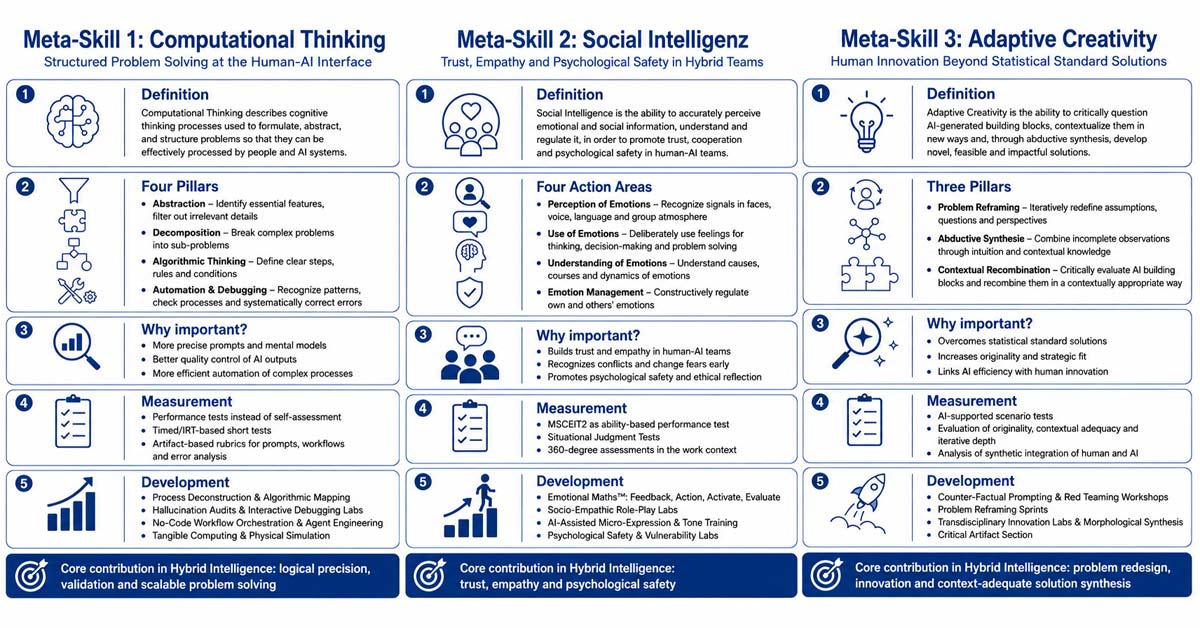
Quick Read
• AI is changing not only what people do at work, but how work is organised. From AI tool to "colleague"Dr. Josef Sawetz is a communication psychologist, marketing psychologist and cognitive neuroscientist who has been involved in university teaching and research since 1990. His work connects psychology, communication, neuroscience and the practical use of AI. The 17th episode of his podcast series Applied Psychology in Daily Life takes a step further into the changing workplace. It looks at a situation that is becoming increasingly familiar: AI is no longer simply a software tool used occasionally by an employee. AI systems, generative models and autonomous agents can increasingly perform parts of knowledge work themselves. The accompanying research paper describes this as Hybrid Intelligence: human and artificial intelligence working together by combining different strengths. AI can process large amounts of information and recognise patterns quickly, while humans contribute contextual understanding, empathy and judgement in situations where the answer is not simply contained in the data.Why three "meta-skills" matterIf AI changes quickly, specialised knowledge can become outdated just as quickly. Sawetz therefore focuses on meta-skills: higher-order abilities that help people learn, adapt and apply knowledge in new situations. The paper identifies three central abilities.• Computational Thinking means structuring complex problems so that humans or AI systems can work on them. It includes abstraction, decomposition, logical instructions, automation and debugging. Importantly, it is not the same as programming. • Social Intelligence concerns the human side of collaboration: recognising emotions, understanding other people's perspectives, building relationships and maintaining psychological safety in teams. • Adaptive Creativity starts where AI-generated output stops. It means questioning the problem, reframing it and adapting or recombining machine-generated ideas so that they actually fit a particular situation. The distinction is useful because AI can produce many possible answers very quickly. The human task increasingly becomes deciding which answer is meaningful, what is missing and how an idea should be adapted to its context. The social side of an AI teamOne of the more interesting aspects of the episode is that AI skills are not presented as purely technical. Social Intelligence becomes particularly relevant when people have to work with AI-driven systems while also working with other people. The research framework breaks emotional intelligence into four abilities: perceiving emotions, using emotions to support thinking, understanding emotional dynamics and managing emotions. In a workplace undergoing technological change, this can mean recognising anxiety about AI, understanding where resistance comes from and creating an environment in which uncertainty and mistakes can be discussed openly. Creativity also changes. Instead of asking only whether AI is "creative", the paper shifts attention towards what humans do with machine-generated possibilities: reframing problems, connecting ideas across domains and judging whether an output makes sense in a particular ethical, strategic or practical context.What changes for HR?This is where the three meta-skills become more than an interesting psychological model. The paper proposes integrating them into the HR value chain, including job descriptions and performance management. Three proficiency levels are outlined, from operational use of predefined AI tools to the strategic design of human-AI systems. Performance assessment could also move away from simply counting outputs, since AI can make the production of text, code or other material much faster. Instead, the proposed criteria include the quality of validation, contribution to team climate and the value added by contextualising and reframing AI outputs. The podcast therefore addresses a broader question than "How should employees learn AI?" Its underlying question is how organisations can redesign work when artificial intelligence becomes part of the working team.The episode is presented in an intentionally accessible format: the content is generated with AI from Sawetz's research and presented through two AI-generated speakers in an informal, conversational style. For listeners who want to go deeper, an accompanying PDF, The 3 Key Meta-Skills in the AI Era, explains the framework, training approaches and HR implications in more detail. The English version is available free of charge here on the site, while the German version can be downloaded free of charge from Sawetz.com. The paper is dated August 2026. 🎙️ AI-generated Podcast
Image: Infographic outlining three key meta-skills for the AI era: Computational Thinking, Social Intelligence and Adaptive Creativity, with their definitions, core pillars, importance, measurement and development methods. |