
15 January 2026 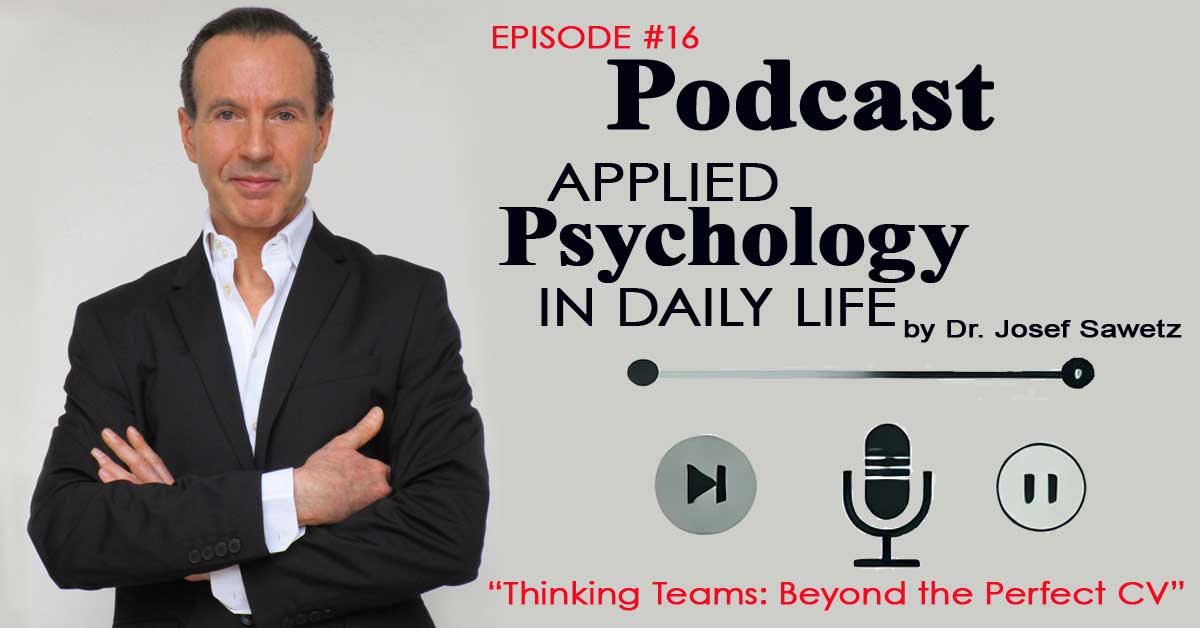 How HR is Redesigning TeamsIn today's Human Resources environment, team building is no longer a simple matching exercise between a job description and a résumé. With improved data availability and the growing use of artificial intelligence, organizations are shifting towards a more dynamic approach. Instead of searching for standardized profiles, HR departments increasingly consider the individuality of employees as a key factor. Skills still matter, but they are now evaluated in relation to specific team needs, challenges, and contexts.AI-supported People Analytics allows companies to simulate team constellations, identify patterns of success, and make more informed decisions. The focus has moved from "Who is the best candidate?" to "Who complements this team under these conditions?" This marks a transition from recruitment as a filling process to recruitment as a design process. Podcast Insight: Rethinking Team LogicIn the 16th episode of the podcast series "Applied Psychology in Daily Life," Dr. Josef Sawetz examines how modern organizations rethink team composition in the age of data and artificial intelligence. Titled *Thinking Teams*, the episode is accompanied by detailed slides available as a PDF, offering listeners additional structure and practical examples.Sawetz challenges the traditional hiring logic and introduces the idea of a "threefold fit": • the task that needs to be accomplished • the skills required to perform it • the personality traits that enable effective collaboration This perspective encourages organizations to think beyond individual performance and instead consider how team dynamics influence outcomes. Homogeneous vs. Heterogeneous TeamsA central theme of the episode is the situational value of team composition. Sawetz argues that diversity is not universally beneficial—it depends on the task. Homogeneous teams can be more effective when speed, trust, and reliability are critical. In contrast, heterogeneous teams are better suited for complex problem-solving, innovation, and navigating uncertainty. The key question is therefore not which team type is better, but which logic fits the specific challenge.From Skills to Systemic FitAnother important takeaway is the limitation of skill-based evaluation. Skills show what a person can do, but they reveal little about behavior under pressure, decision-making styles, or interaction patterns within a group. By linking skill profiles with personality dimensions and contextual data, organizations can make more nuanced decisions. According to Sawetz, tools such as AI agents can support this process by structuring data, anticipating team outcomes, and making decisions more transparent—provided that data protection and ethical standards are respected.In the end, the episode suggests that successful teams are not built solely on qualifications or personal preferences. More often, effectiveness depends on how well individuals align with a specific role, a concrete task, and the people they work with. A sharp listen for anyone rethinking how teams are built today. Spoken by two AI-generated voices, it mirrors the podcast's focus on data, fit, and technology-driven team design. 🎙️ AI-generated Podcast
Image: The visual for 'Thinking Teams: Beyond the Perfect CV,' the 16th episode of the podcast series 'Applied Psychology in Daily Life,' shows a portrait of Dr. Josef Sawetz. |